A tree can look smaller after a crew cuts it back, but that does not mean the work was good for the tree. In the conversation around tree pruning versus topping, the difference comes down to where cuts are made, how the tree responds, and whether the work reduces future risk or creates more of it.
For Middle Tennessee property owners, this matters most when mature trees are close to homes, driveways, power lines, parking areas, or outdoor spaces. Proper pruning can improve clearance, remove hazardous limbs, and help a tree maintain a strong structure. Topping may provide an immediate change in height, but it often leaves behind weak growth, decay, and a tree that becomes harder and more expensive to manage.
What Proper Tree Pruning Does
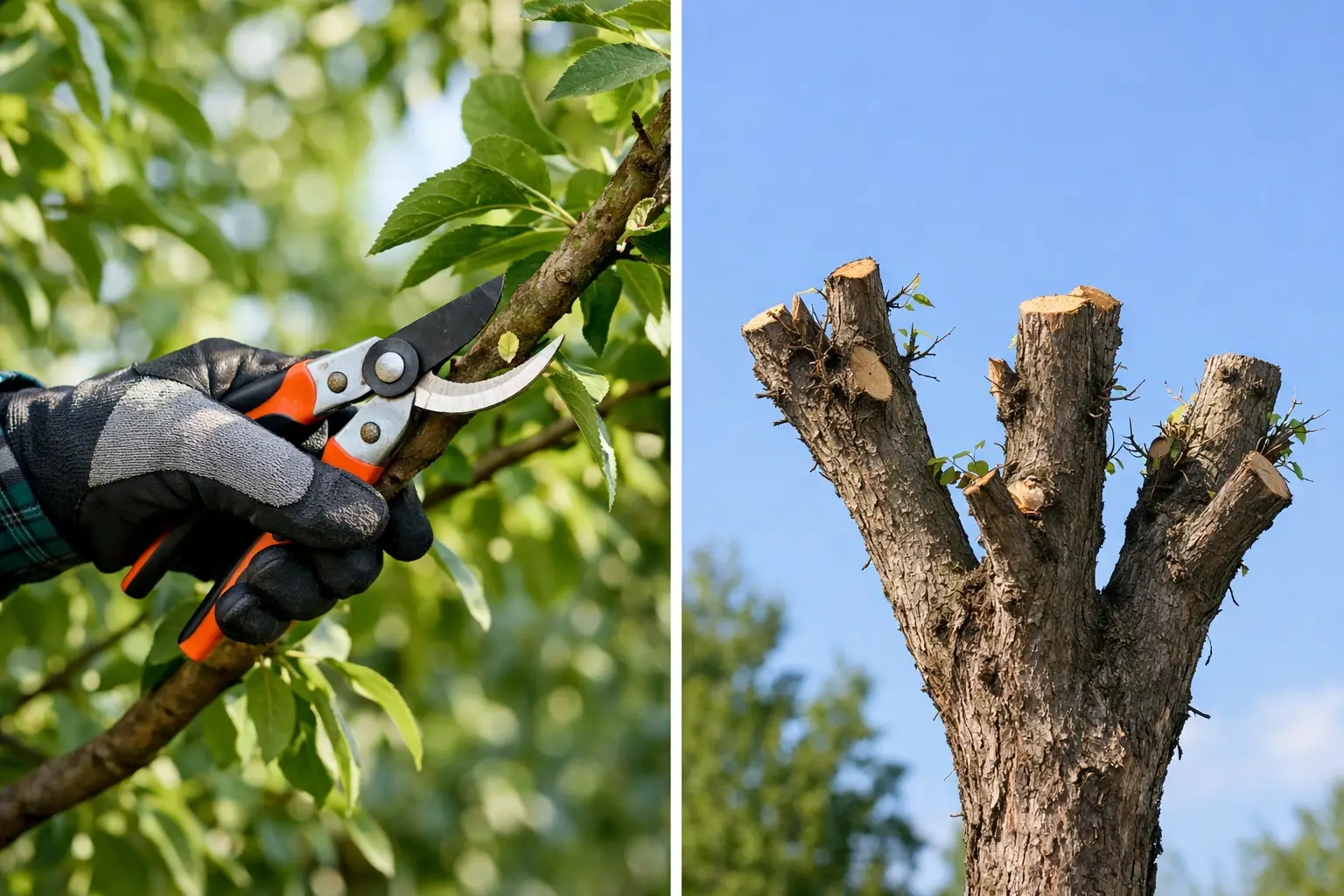
Tree pruning is the selective removal of branches to improve a tree’s health, structure, clearance, or safety. The goal is not to make every limb shorter. The goal is to make thoughtful cuts that work with the tree’s natural form.
A qualified crew may remove dead, diseased, rubbing, broken, or overextended limbs. They may thin crowded areas of the canopy so wind can move through more naturally, or raise lower branches that interfere with a roof, sidewalk, mower, driveway, or commercial parking lot. When a tree has grown too close to a structure, reduction pruning can shorten a branch back to a healthy lateral branch that is large enough to take over the growth.
That last detail is important. Proper cuts are made at the branch collar or at a suitable lateral branch, not at a random point in the middle of a limb. The tree has a better chance to seal the wound and direct growth into branches that can support it.
Pruning is not a guarantee that a tree will never fail. A hollow trunk, extensive root damage, severe decay, or a tree leaning toward a target may require removal instead. But when the tree is fundamentally sound, careful pruning can reduce risk while preserving shade, curb appeal, and long-term value.
What Tree Topping Means
Topping is the indiscriminate cutting of a tree’s main stems or large branches back to stubs, usually to reduce overall height quickly. It is sometimes called heading, hat-racking, or cutting a tree back hard. The result can look dramatic: a full canopy becomes a set of bare, blunt ends.
Topping is usually requested because a tree feels too tall, blocks a view, drops leaves, or appears threatening after a storm. Those are understandable concerns. The problem is that a topped tree often responds in ways that make the original concern worse.
When a large amount of canopy is removed at once, the tree loses a major part of its food-producing leaf surface. It may respond by sending up many fast-growing shoots near the cut points. These shoots are commonly called water sprouts or epicormic growth. They grow quickly, but they are often attached more weakly than naturally developed branches.
The large wounds left by topping can also expose wood to decay organisms. Some trees compartmentalize wounds better than others, but no tree benefits from unnecessary, oversized cuts. A topped tree may survive, yet survival is not the same as health or structural safety.
Tree Pruning Versus Topping: The Safety Difference
The most concerning part of topping is what happens after the crew leaves. New shoots can become long and heavy in only a few growing seasons. Because they originate from stressed tissue near a large wound, they may be more likely to break than a properly attached limb.
That means a tree topped to make it safer can eventually develop a dense crown of weak branches above the same house, fence, road, or gathering area. The tree may also need repeated cutting to keep the sprouts under control. What started as a one-time shortcut can become a recurring maintenance problem.
Proper pruning takes more judgment up front. A trained professional considers branch unions, visible defects, canopy weight, clearance needs, species, tree age, and the targets below. A mature oak over a Murfreesboro driveway and an ornamental pear beside a Nashville storefront do not need the same approach.
There are times when a substantial reduction is appropriate. If a long limb is extending over a roof or a co-dominant stem has developed excessive end weight, reduction cuts may be used to shorten the branch while retaining a healthy lateral branch. This is not topping. The work is targeted, and the remaining structure is intentional.
Why Topped Trees Often Cost More Later
Topping can appear less expensive because it is fast. But the lower price on the first visit can overlook the follow-up work a damaged tree may require. A topped tree may need more frequent trimming, corrective pruning, cabling or bracing in limited cases, storm cleanup, or full removal if decline and decay progress.
Property owners should also consider appearance. Mature trees contribute shade and character to homes, apartment communities, office properties, and neighborhood entrances. A badly topped tree can look unnatural for years, even if it pushes out new growth. If the tree declines, the cost of removal and replacement can be far greater than the cost of proper pruning from the start.
For commercial properties and HOAs, topping can create another issue: inconsistent grounds appearance. A maintenance plan based on sound pruning practices is easier to budget for and helps keep trees clear of signs, lighting, sidewalks, rooftops, and parking areas without sacrificing the landscape.
When a Tree Is Too Large for Its Space
Sometimes a homeowner is told, “This tree just needs to be cut back,” when the honest answer is more complicated. A tree that has outgrown its planting location may not have a permanent pruning solution.
For example, a large, mature tree planted close to a house cannot always be reduced enough to solve roof clearance or utility concerns without causing serious stress. Repeated hard cutting can turn a manageable tree into a hazard. In that situation, removal may be the safer, more practical choice, followed by planting a species that better fits the available space.
The same is true for trees with storm damage. After high winds or ice, a broken limb may leave a jagged canopy that looks like it needs to be cut evenly across the top. Instead, the right response is usually to remove broken material and make clean, selective cuts where the remaining branches can continue to grow safely. If the trunk or major stems are compromised, removal may be warranted.
What Good Pruning Looks Like
Good pruning does not always produce a perfectly symmetrical tree. Trees are living structures, not hedges. A well-pruned tree should still look natural from the street while having better clearance, less deadwood, and a more balanced canopy.
The amount removed depends on the species, condition, and purpose of the work. Young trees can benefit from structural pruning that encourages a strong central leader and well-spaced branches. Mature trees usually need a lighter hand. Removing too much live canopy in one visit can stress even a healthy tree, particularly during drought, heat, or other environmental strain.
Timing also depends on the tree and the work needed. Dead or hazardous limbs should not wait for an ideal season if they threaten people or property. For routine maintenance, dormant-season pruning is often useful because structure is easier to see and some trees experience less stress. Still, there is no single calendar rule for every species and every situation.
Questions to Ask Before Approving Tree Work
Before hiring a tree service, ask what problem the work is intended to solve. Is the concern deadwood, roof clearance, storm damage, excessive limb weight, blocked access, or a tree that is structurally unsound? A clear answer helps determine whether pruning, reduction, removal, or another option is appropriate.
Ask where the cuts will be made and whether large branches will be left as stubs. You should also ask how the crew will protect the lawn, driveway, landscaping, fence, and nearby structures, as well as whether cleanup is included. Professional tree work requires planning, appropriate equipment, and a crew that understands how to manage falling material safely.
A dependable estimate should explain the recommended scope without pressuring you into unnecessary work. If the safest recommendation is removal, a reputable company should say so plainly. If a tree can be preserved with selective pruning, the work should be designed to preserve it rather than simply make it look shorter for the moment.
Men in Green provides practical tree assessments and precision pruning for property owners across Middle Tennessee, with safety, clear communication, and full cleanup at the center of the job.
If a tree near your home, business, or community has become a concern, do not settle for a quick cut that creates a bigger problem later. Have the tree evaluated with its condition, location, and long-term safety in mind, then choose the work that gives your property the best path forward.