A leaning pine near a playground, dead limbs over resident parking, and overgrown trees blocking a stop sign are not landscaping details. They are board-level safety and property-value concerns. The right HOA tree maintenance contractor helps a community address those issues before they become storm claims, resident complaints, or expensive emergency work.
For HOA boards and property managers, tree care is rarely a one-time decision. Mature trees need seasonal attention, common areas need to stay presentable, and hazards can develop quickly after high winds, heavy rain, ice, or construction activity. A dependable contractor should make that responsibility easier to manage with clear recommendations, safe work practices, reliable scheduling, and a clean job site when the work is finished.
Start With the Community’s Actual Needs
Not every HOA needs the same level of tree service. A small neighborhood with a few entrance trees may need periodic pruning and storm response. A larger condominium community, apartment property, or subdivision with wooded common areas may need a recurring maintenance plan that covers trimming, hazardous tree removal, stump grinding, brush clearing, and seasonal inspections.
Before requesting estimates, take inventory of the areas the association is responsible for. Focus on trees near homes, sidewalks, mailboxes, utility lines, roads, parking areas, signs, pools, playgrounds, and community entrances. Also note drainage areas, retention ponds, wooded buffers, and vacant lots that can become overgrown or hide fallen limbs.
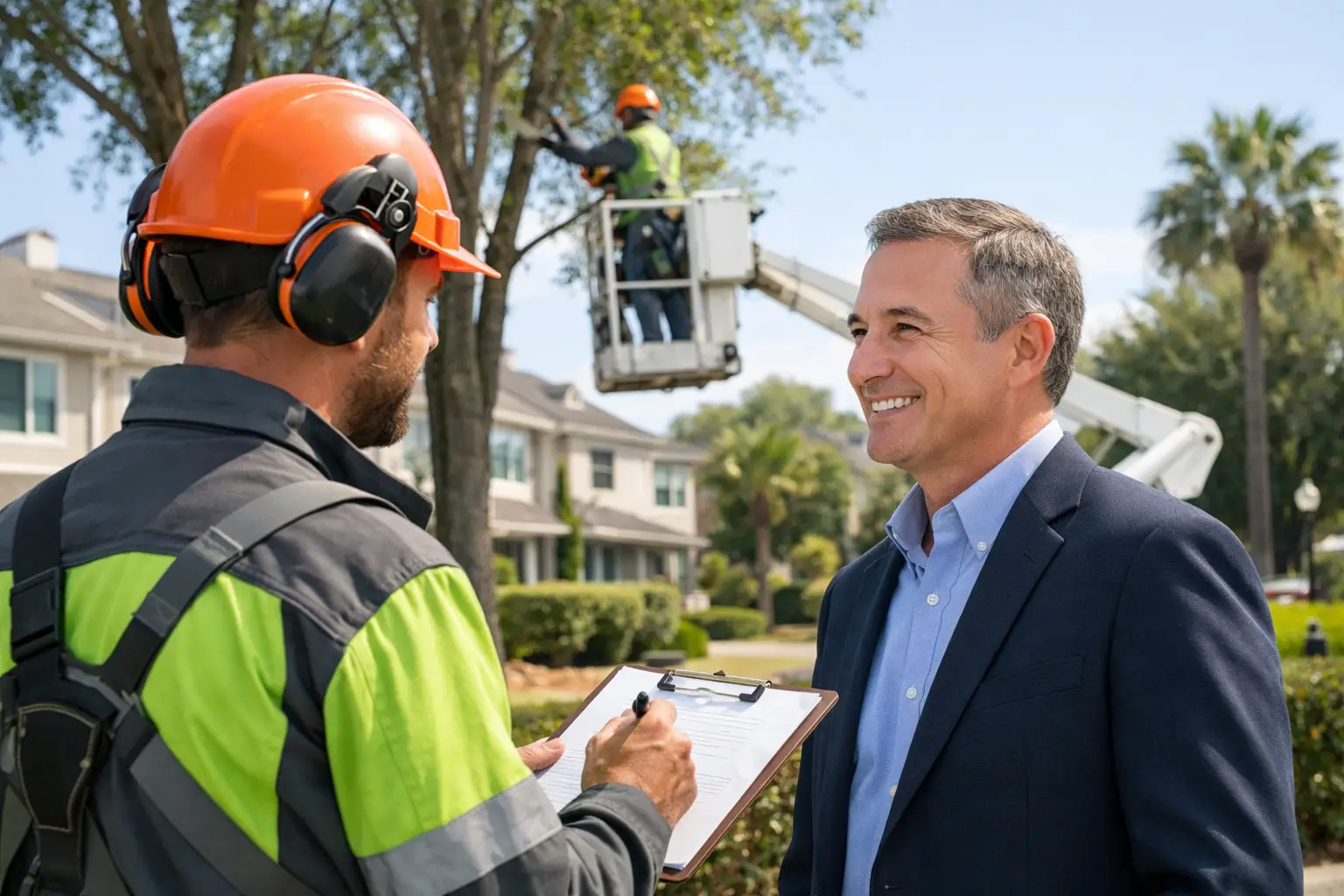
This step helps the board ask for the right scope of work. It also prevents a contractor from pricing only the most visible problem while larger risks remain unaddressed. A good contractor will walk the property with a board member or manager, ask questions about recurring issues, and separate urgent hazards from work that can be planned over time.
What an HOA Tree Maintenance Contractor Should Handle
The best contractor is not simply the crew that can remove a tree quickly. HOA work requires planning around residents, shared property, access restrictions, appearance standards, and the association’s budget cycle.
Tree Risk and Hazard Assessment
A qualified crew should be able to identify obvious warning signs: dead or hanging limbs, split trunks, cracked branch unions, root damage, decay, trees leaning toward structures, and limbs interfering with traffic visibility. No contractor can guarantee that a tree will never fail, but experienced assessment helps the board prioritize the conditions that deserve prompt attention.
Middle Tennessee weather can expose weaknesses quickly. Storms may break limbs that were already stressed, saturate soil around shallow-rooted trees, or create damage high in the canopy that is not visible from the ground. After a significant weather event, an HOA should not rely on residents to judge whether a damaged tree is safe.
Pruning That Protects Appearance and Tree Health
Routine trimming should improve clearance and structure without stripping a tree or leaving it misshapen. Proper pruning can keep limbs away from roofs and light poles, improve visibility at intersections, reduce low-hanging branches over walkways, and maintain a cleaner appearance around common areas.
Ask how the contractor decides what to prune. The answer should involve the tree’s condition, branch structure, clearance needs, and long-term health, not just cutting every branch back as far as possible. Aggressive topping can create weak regrowth and leave a tree looking worse than before.
Removal, Stump Work, and Full Cleanup
When removal is the safer option, the contractor needs the equipment and experience to work around homes, vehicles, landscaping, fences, and utilities. Some trees can be safely dropped in an open common area. Others require controlled dismantling in sections. The method depends on the tree’s size, location, condition, and nearby targets.
Boards should also clarify what happens after removal. Will the stump be ground? Will surface roots be addressed if they are lifting sidewalks or creating mowing problems? Is debris hauled away? Are wood chips left only if requested? A clear estimate avoids frustration after the tree is gone but the site is still unusable.
Verify Safety, Insurance, and Communication
Tree work has real risk, especially in occupied communities. A lower price is not a savings if the crew damages irrigation, blocks resident access without notice, leaves debris in common areas, or lacks the coverage to handle an accident.
Ask the contractor to provide proof of current insurance and explain how the crew protects nearby property. The board should know who will be on site, how vehicles and pedestrians will be managed, whether equipment needs gate access, and what areas may be temporarily closed during the work.
Communication matters just as much as equipment. Residents do not need a lengthy technical report, but they do need reasonable notice when parking spaces, roads, sidewalks, or amenities may be affected. A contractor who coordinates with the property manager and follows the agreed schedule helps the board maintain resident trust.
For emergency work, ask about response expectations before the next storm arrives. A contractor may not be able to promise immediate service during a region-wide event, but they should be honest about availability, triage dangerous situations, and communicate clearly about next steps.
Compare Estimates Beyond the Bottom Line
An HOA should receive written estimates that describe the work in plain language. A useful proposal identifies the trees or work areas, explains whether pruning, removal, stump grinding, or cleanup is included, and notes any access or site conditions that could affect the job.
Be cautious with estimates that are unusually vague or dramatically lower than the others. The difference may be legitimate, but it may also mean debris hauling, stump work, traffic control, or difficult access was not included. Ask questions before approving the work, not after the crew arrives.
Price still matters. Associations have budgets and fiduciary responsibilities. But the lowest bid is not always the most responsible choice when the work involves large trees over homes or shared spaces. Consider experience, safety practices, reputation, communication, equipment, scope clarity, and cleanup alongside cost.
Use a Maintenance Plan Instead of Waiting for Problems
Reactive tree service costs more because it often happens under pressure. A fallen limb over a driveway, a tree blocking the entrance, or storm damage near a building calls for immediate action. Regular inspection and planned pruning give the HOA more control over timing and budget.
A practical maintenance schedule may include a seasonal review of common areas, pruning before branches interfere with structures or signs, removal of identified deadwood, and periodic attention to wooded edges and vacant lots. The schedule should fit the property. A heavily treed neighborhood needs more oversight than a newer community with limited mature landscaping.
Recurring service also gives the contractor context. The crew becomes familiar with access points, resident traffic patterns, known problem trees, and the board’s expectations for cleanup. That familiarity can make future work more efficient, especially when urgent weather cleanup is needed.
Questions to Ask Before Hiring
A short conversation can reveal whether a contractor understands HOA responsibilities. Ask whether they have worked on occupied communities and how they handle resident safety during active work. Ask what insurance coverage they carry, whether the estimate includes cleanup and stump work, and how they communicate schedule changes.
Also ask how they approach tree risk. A trustworthy contractor should not push removal when pruning or monitoring is reasonable. At the same time, they should be willing to explain plainly when a tree’s location and condition make removal the safer recommendation.
For communities in Rutherford, Davidson, and Williamson counties, local experience is useful. Soil conditions, common tree species, storm patterns, and access challenges vary across Middle Tennessee. Men in Green brings more than 30 years of regional tree care experience to HOA and commercial properties, with hands-on assessments, professional equipment, and full cleanup.
A Better Standard for Shared Property
HOA tree care is about more than keeping entrances neat. It protects residents, preserves usable common areas, supports curb appeal, and helps boards avoid preventable emergencies. The contractor you choose should respect that responsibility from the first walkthrough through the final cleanup.
When a board has a clear scope, a realistic maintenance plan, and a contractor that communicates honestly, tree work becomes one less unpredictable part of managing the community. Start with the trees that could affect people and property, then build a plan that keeps the whole neighborhood safer and better cared for.